
Prefer to listen? I recorded this post as a podcast episode just for you. Just hit Play!
If you have ever had an X-ray and wondered about the person behind the machine, this post is for you. As a Registered X-ray Technologist/ Radiographer with over 20 years of clinical experience, I get asked this question all the time. Whether you are a student exploring your options or someone looking for a meaningful career change, here is everything you need to know about becoming an X-ray technologist, straight from someone who has lived it.
Why I Chose This Career
I have always loved science, but what truly drew me in was the idea of imaging the human body. There is something remarkable about being able to look inside a person and give a physician the information they need to help them. The moment I understood that this career blended science, technology, and direct patient care, I knew it was right for me. Over two decades later, that feeling has never changed.
What Does the Training Actually Look Like?
One of the first things to understand is that you do not need to attend a traditional university to become an X-ray technologist. Programs are offered at colleges and polytechnic institutes around the world, and many of the best ones are hands-on, applied learning environments. No matter where you live, your first step is to get in touch with the post-secondary schools in your country or region to find out what accredited programs are available near you.
One of the things I love about this career is that once you are qualified, the world opens up to you. X-ray technologists are in demand globally, and many techs use their credentials to travel and work in different countries. It is truly a portable career.
I am based in Canada, so the programs I am most familiar with are the ones here. Here is a look at some of the schools that offer Medical Radiography or Medical Radiologic Technology programs across the country.
Accredited Programs Across Canada
Canada offers a range of accredited programs through universities and colleges, equipping students with theoretical knowledge and clinical skills. These programs combine classroom learning, laboratory simulations, and clinical placements in various healthcare settings.
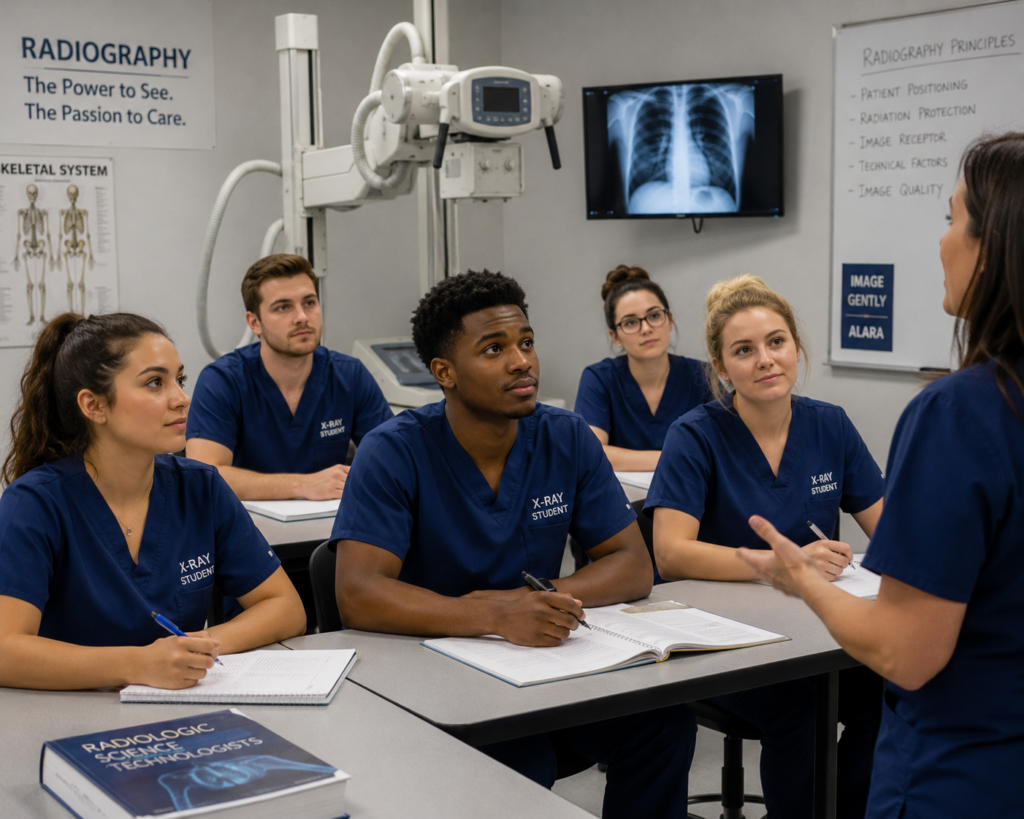
Here are some of the schools that offer Medical Radiography or Medical Radiologic Technology programs in Canada:
- British Columbia: BCIT (British Columbia Institute of Technology) offers a Medical Radiography diploma program accredited by the Health Standards Organization through the EQual Canada program. Camosun College and College of New Caledonia also offer programs in BC.
- Alberta: SAIT (Southern Alberta Institute of Technology) offers a Medical Radiologic Technology diploma that spans two and a half years, combining theoretical knowledge, clinical skills, and practicum rotations in radiology departments.
- Saskatchewan: Saskatchewan Polytechnic offers a nationally accredited two-and-a-half-year advanced diploma program in Medical Radiologic Technology at their Saskatoon Campus.
- Ontario: Approved Ontario programs include Mohawk College of Applied Arts and Technology in partnership with McMaster University, The Michener Institute of Education at University Health Network, and St. Clair College of Applied Arts and Technology, among others.
The National Certification Exam
Once you complete your program, you are eligible to write the national certification exam administered by the Canadian Association of Medical Radiation Technologists, known as the CAMRT. Upon successful completion of the exam, students are granted Registered Technologist status and are eligible to work throughout Canada.
What Surprised Me Most
When I went through my training, I did not fully appreciate how broad this career would be. One of the biggest surprises was learning that X-ray technologists work in the operating room. Yes, the OR. When a patient is undergoing bone surgery, we are part of that team. We operate a specialized piece of equipment called a C-arm, which allows the surgeon to view the patient’s bones in real time and place internal fixation devices, like screws and plates, with precision. We also perform contrast studies in the OR, such as cystograms, where a urologist needs to visualize the kidneys or bladder during a procedure. That kind of responsibility is not something most people expect from this career.
The Biggest Misconception About Being an X-Ray Tech
Most people assume this job is straightforward. You take a picture, the doctor reads it, done. The reality is far more complex, and that is something I want every aspiring tech to understand before they start.
When a patient comes in for imaging, it is usually just the two of you in that room. The physician has not seen the patient yet. That means the responsibility for producing diagnostic, optimal images falls entirely on you. You have to understand anatomy, pathology, positioning, and technique well enough to know, in the moment, whether what you captured is going to give the radiologist what they need to make a diagnosis. There is no one to check your work before it matters. That level of accountability is something I am proud of, and it is something you need to be ready for.
The Skills That Make a Great X-Ray Technologist
Beyond the technical knowledge you will gain in school, there are personal qualities that truly define a great technologist.
Communication
This is the one I talk about most. A patient is trusting you with their body. Many of them are in pain, scared, or confused. You need to be able to give clear and concise instructions to ensure the procedure goes smoothly. Whether you are asking someone to hold their breath, position their arm a certain way, or stay still despite discomfort, how you communicate directly affects the quality of your images and the comfort of your patient.
Ability to Handle Responsibility
You are working with radiation. That alone requires a serious, disciplined mindset. During your program, there is a significant amount of coursework and testing you must complete before you ever step into a clinical environment. That process exists for good reason, and the students who thrive are the ones who embrace that responsibility rather than rushing past it.
Composure Under Pressure
Whether you are in the emergency department imaging a trauma patient or assisting in a surgical case, you need to be calm, focused, and methodical. This is not a career for someone who shuts down under pressure. It is, however, an incredible career for someone who rises to it.
My Advice If You Are Seriously Considering This Path
After more than 20 years in this field, here is what I would tell anyone who is genuinely interested in becoming an X-ray technologist.
- Talk to someone already working in the field. Ask them where they trained, what their day-to-day looks like, and what they wish they had known. Real conversations with real technologists will give you information no brochure can.
- Try to arrange a job shadow experience. If you can spend even a few hours observing in a clinic or hospital imaging department, do it. Seeing the work firsthand will confirm whether this is the right fit for you.
- Research programs carefully. Look for accredited programs recognized by the CAMRT, and consider the clinical placement opportunities each school offers.
- At the end of the day, if you want to help people, if you are curious about the human body, and if you want a career that keeps you on the dynamic, ever-evolving side of healthcare, Medical Imaging Technology might be exactly what you are looking for.
A Note From Someone Who Never Stopped Loving This Profession
I became an X-ray technologist because of a passion for science and imaging. What I did not expect was how deeply this career would shape everything that followed. My clinical experience gave me a level of expertise and insight that has carried into every business I have built, including XrayMarkers.ca, where I design and sell custom radiographic, side markers/ X-ray markers for technologists and students around the world. We serve MRTs/Radiographers in Canada, England, Australia, South America, and beyond, because I saw a need in this profession and wanted to help fill it.
If you are drawn to this field, trust that instinct. It is a career that will challenge you, fulfill you, and if you let it, inspire you in ways you never expected.