
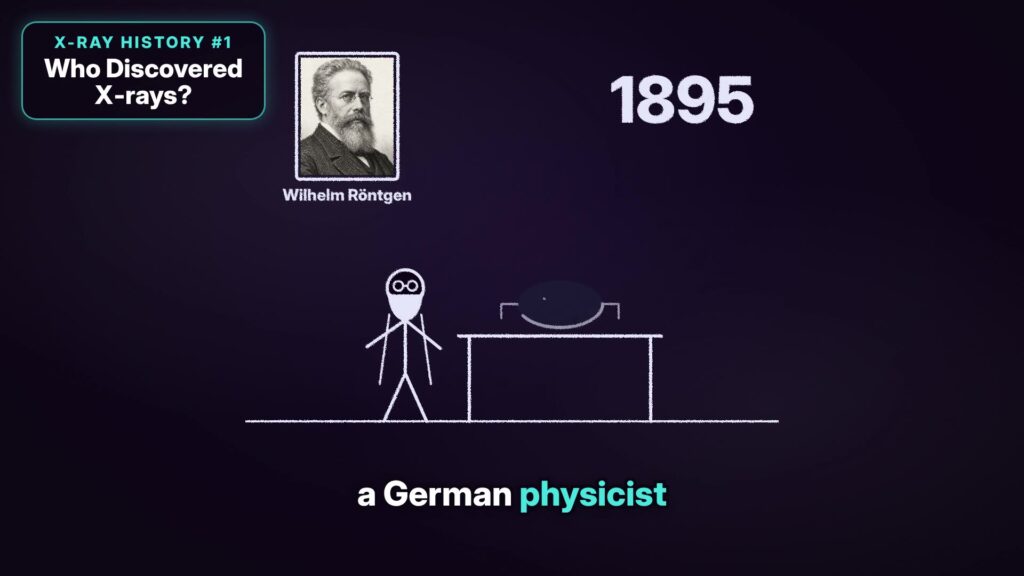
Every X-ray taken today, in every hospital, clinic and emergency department, traces back to one evening in a dark German laboratory. Here is the story of how X-rays were discovered, told in under a minute.
A Glowing Screen in a Dark Lab
On November 8, 1895, the German physicist Wilhelm Conrad Röntgen was working late at the University of Würzburg. He was experimenting with a glass vacuum tube, passing electricity through it. To block out its light, he covered the tube completely with black cardboard.
Then something strange happened. Across the room, a screen coated with a fluorescent chemical began to glow. No light could get through the cardboard, yet something invisible was travelling through it and lighting up the screen.
Why He Called It “X”
Röntgen did not know what these rays were. In mathematics, X is the symbol for an unknown, so he named them X-rays. In many countries they are still called Röntgen rays, and the unit of radiation exposure, the roentgen, carries his name.
The First X-ray of a Person
Within weeks, Röntgen discovered that the rays passed through soft tissue but were blocked by bone. On December 22, 1895, he made an image of his wife Anna Bertha’s hand. Her bones, and the ring on her finger, appeared clearly on the photographic plate. It is one of the most famous images in the history of medicine.
News of the discovery spread around the world in a matter of weeks, and doctors began using X-rays to find broken bones and swallowed objects almost immediately.
The Very First Nobel Prize in Physics
In 1901, Röntgen received the first Nobel Prize in Physics ever awarded. He chose not to patent his discovery, so that it could be used freely to help patients everywhere.
Why It Still Matters to X-ray Technologists
Today we celebrate November 8 as the International Day of Radiology, the anniversary of Röntgen’s discovery. Every image a technologist takes, from a chest X-ray in the ER to imaging in the OR, builds on that one night in 1895.
And one thing has not changed since the very first X-rays: a radiograph is only useful when everyone knows which side is which. That is why technologists still place a right or left marker on every image.
If you are a technologist or student, we make custom X-ray markers and radiology apparel designed for people like you. Visit Xraymarkers.ca to create your own set.
This is episode 1 of our X-ray History series. Follow us on YouTube, Instagram, Facebook and TikTok for more.